Display Comb 4

/ featured media, post meta, title, read more link and full content

Below is my response to this letter from Pete Sessions. Keep in mind, he is up for re-election next March.

Thank you for your response. Although you made some good points, I do not agree with the direction you and other members of congress are taking in regard to Net Neutrality and protecting the FCC. Furthermore, I am extremely unhappy with the service AT&T and other Internet Service Providers (ISPs) provide and wanted to elaborate on that. Additionally, Ajit Pai’s recommendation is one sided and is beneficial only to ISPs, not the consumer. I feel it is your duty, as our representative, to ensure our interests and rights our protected. As you emphasized, not just small business, but all business has thrived off of an open Internet that is definitely not free.

I feel that currently the FCC protects three basic rights and protections: no blocking, no throttling, and no paid prioritization. I have no doubt given many of Ajit Pai’s comments, that his priority is to undo those protections. These protections stopped Comcast from denying access to p2p services without notifying customers, AT&T blocking Voice Over IPs (VOIPs) services like Skyle, MetroPCS blocking sites like YouTube, multiple ISPs blocking products like Google Wallet, Verizon attempting to block tethering apps, and more. Clearly the reason these ISPs have taken such action, more than bandwidth concerns, are concerns that they would lose revenue from competing products.

Additionally, I think fundamentally “the press”, that is protected by our Constitution and fundamental to free speech has changed as has the public forum. If you take away protections and rights established by the FCC, you undermine free speech itself. This issue is greater than just the economy, it is fundamental to our underlining freedoms that have made this country so great. Your vote can either protect or jeopardize that freedom.

I also want to respond to your comment on innovation. The level of innovation resulting from the internet is staggering. Little of that innovation has come from ISPs. Additionally, they are using little to none of the proceeds of their ISP business to invest in new internet infrastructure. The majority of people in your district only have one choice for ISP. It is that monopolistic behavior that was fundamentally behind the creation of the FCC and the Telecommunication Act of 1996. Furthermore, I suspect AT&T has become a greater monopoly than Bell Telephone itself, which is ironic.

Thank you for taking the time to contact me regarding net neutrality. I appreciate you taking the time to share your thoughts with me on this important issue.

The Internet has revolutionized how we learn, shop, communicate, innovate, and do business. Small businesses across Texas thrive off a free and open Internet. But since the Federal Communications Commission (FCC) took a drastic step during the closing days of the Obama Administration to apply a 1930s-era ‘Title II’ regulation to the Internet, costs for consumers skyrocketed, innovation was hindered and broadband deployment decreased significantly, particularly in rural America.

Simply put, these rules would have given the federal government unchecked authority over the Internet and destroyed the light-touch framework that has protected a free and open Internet for the past 20 years. Claims that Congress and the Trump Administration are disabling long-standing privacy regulations are simply inaccurate, given the Obama Administration’s decision was nothing less than a federal takeover of the Internet.

Americans’ data is regulated under Section 222 of Title 47 of the U.S. Code. The recent proposal unveiled by the new FCC Chairman, Ajit Pai, would end political uncertainty of internet regulation, restore the Federal Trade Commission’s (FTC) jurisdiction over privacy practices and unite privacy law under a single, clear framework. In case you were not aware, the FTC has previous experience overseeing consumer online-privacy rights and has been able to enhance innovation and jobs in its prior competitive state.

Please know that the new privacy protections have not yet been finalized, but my colleagues and I are working to ensure that any possible regulatory or legislative solution ultimately protects the principles of a free and open Internet. Most importantly, I believe it is imperative for the federal government to encourage marketplace consistency to ensure that the Internet is open, available, fast, and reliable for all Americans.

Again, thank you for taking the time to contact me and share your views on such an important issue. Should you have any additional questions or concerns, please feel free to contact me at 202.225.2231 or Sessions.LegStaff@mail.house.gov. I look forward to hearing from you in the future.

Sincerely,

Pete Sessions
Member of Congress

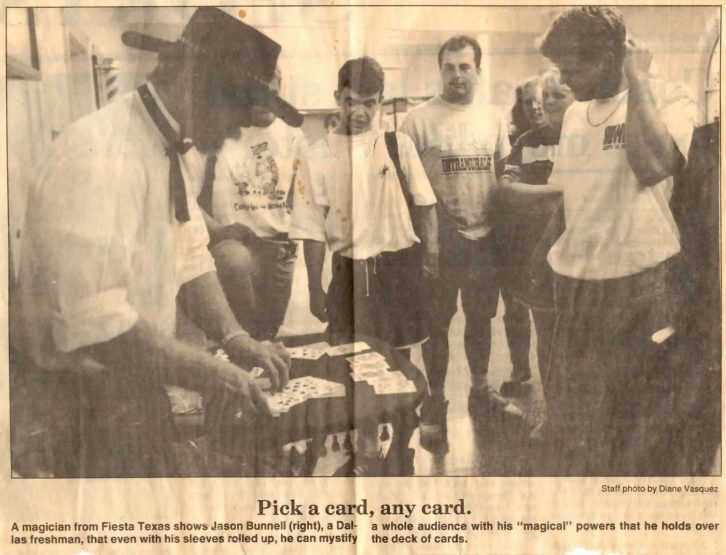
The best trick I ever saw was my freshman year of college. A card shark wanted to show how old riverboat gamblers cheated at cards. The thing was, I didn’t know the real trick until last night about 25 years later. An Austin director made a documentary on that man, Richard Turner. BUT WAIT! Don’t watch the preview just yet! It wasn’t until I watched the preview that the true magic was revealed.

When I saw this man perform at Baylor, they put a picture of it in the paper with my name, so I kept it. He said he wanted people to see how old riverboat gamblers and professional cheats did it. He said he could tell what the cards were by weight. He said he could feel the difference in weight between an 8 of clubs and an 8 of spades. I figured there must be more to it than that, but I could not see it. Maybe there was a slight difference in weight from ink, but it would have to be so minuscule as to be impossible for the human hand to detect. As a kid, I had a magic set and thought I might catch him with misdirection. He did some other tricks where he asked if people had business cards and would count them and get a feel for them, hand them to another, and ask yet another to remove some cards and by weight would say how many he had left. There were a number of variations of that, but it just didn’t seem like a trick of misdirection or typical card tricks. I found a YouTube video of Richard doing a card routine. See if you see anything strange. Don’t try to solve the trick, just see if you can spot anything odd or a little different about the man himself.

Did you spot it? I was right in front of the guy and I never spotted the best part. It is far more amazing than the card tricks he was able to do. The real trick is how he is actually doing them. I did not see the premiere of but heard about it. On the site, you can see a little about the real magic. Go check out the preview at the Dealt movie site. Truly unbelievable. Just more proof that our disabilities make us greater and greater still. I have dyslexia and though not as challenging as blindness, it did have a huge impact on my life and I feel I have adjusted to those challenges and those adjustments have made me stronger. I think Richard is a great example of how people can do amazing and unbelievable things with their disables.

My grandfather, Paul Bunnell, passed away last in February of last year. A few of his effects were passed on to me including this old pocket watch. The watch does not seem to work, but I have been told it is fixable. You can see details about this and other pocket watches on this site. It seems to have a cool history and I wish he told me how it came into his possession. The watch was model 1857 and estimated to be produced in 1859 or 1860. So about 160 years old. The total production of this particular watch was about 800 units. The movement contains 11 jewels, which is named after Royal E Robin who I discuss below. It is not considered to be “railroad grade“, which is a type of chronometers pocket watch that keep extremely accurate time despite changes in climate. In fact, there is a fantastic book about the development of the chronometer to solve the mariners problem of longitude in the book Longitude: The True Story of a Lone Genius Who Solved the Greatest Scientific Problem of His Time, which I read in 2015.

The American Waltham Watch Company was based in Waltham, Massachusetts and produced watches from 1852 to 1957. So this watch was definitely one of their earlier watches. Waltham is about 10 miles west of Boston. Of course the factory has been converted to lofts, but cool enough, the building still stands.  American Horologe Company, who went bankrupt and was sold at auction to Royal E Robin, merged with Waltham in 1857. Horologe was started by 3 men who wanted to make less expensive but still high quality watches by making interchangable parts. This was the same strategy employed by Henry Ford in 1903 to make a better automobile and his legacy needs no commentary. This watch was designed around the time of the merger and the movement was named after Royal E Robin, who was also the company’s treasurer until his death in 1902. At the time the watch sold for about $12, which was a pretty good sum. If you assume that $1 dollar was equal to one ounce of silver (because the US dollar used to be tied to gold and silver), then this would be about a $300 watch. That company went through some hard times as the Civil War broke out in 1860. Interestingly Abraham Lincoln owned a similar watch made by Waltham Watch Company of the same size and number of movements that was made in 1863, just 3 years after the one I have. You can see a more complete history here.

I just finished the book Moonwalking With Einstein – The Art And Science of Remembering Everything by Joshua Foer. I enjoyed the book, but would only give it 3 out of 5 stars. Unlike other non-fiction books like The Code Book, I felt this book did little to actually show you how to do a lot of the things discussed in the book, which was what I really wanted. This was really little more than a man talking about his experience with learning how to improve memory. I wanted to briefly describe the methods mentioned in the book but also comment on a few concepts that I thought particularly interesting.

Methods

The Method of Loci basically uses rooms you are familiar with and furniture in those rooms, and simply placing the items you want to memorize on these items of furniture. It is also called the Memory Palace Technique. A great video shows a two time US Memory Champ Ron White teaching a 6 year old this method to memorize all the US presidents in an hour. Ron White, the man from the linked video was also on Stan Lee’s Superhuman show on the History Channel. He also has a fantastic YouTube channel that teaches several memory techniques. What is interesting is that everyone that has learned memory systems like the Loci Method insist a person of average intelligence could do it in a few minutes of practice. In fact, Ed Cooke, who first taught the author the Loci Method, says he thought someone could win the US Memory Championship with just a few hours of practice a day. And that is exactly what the author does. Another application of this same technique was by Dr Chooi where he used is own body as the Loci to memorize a dictionary! “Dr. Yip Chooi, the effervescent Malaysian memory champ, used his own body parts as loci to help him memorize the entire 56,000-word, 1,774-page Oxford Chinese-English dictionary.”

Another method described is the Person Action Object or PAO method. This method is used to memorize numbers. For each digit from 0 to 9, one would have some person that is very memorable. And it is best not to use close friends or family. Santa Claus is a better option than your mom unless you want to picture your mom doing unspeakable acts in order to memorize a number. In addition to having 10 people for each digit, you would do the same for actions and objects. Lewd, silly, or gross is better than normal because they are more memorable. So maybe you choose Santa Clause to represent 7 because Christmas is on the 25th and 2 + 5 = 7. Farting (the action) is a 4 for no particular reason. And the object for 9 is your dream car: a cherry red 911 Porsche Turbo. So if you needed to memorize a phone number starting in 749, you would picture Santa Clause farting on a cherry red Porsche INSIDE your mailbox (or whatever is your #1 position in your Loci). Then perhaps Marvin the Martian is puking on your laptop right on your driveway (your second Loci position). And so on.

I am not sure the last method was really given a name, but ironically it was to remember names. But the idea was to have a picture associated with the most common names. If you sign up for an email, you can get a list of the top most 100 male and female names with great images for each from Ron White, the link is in the notes of this video. So if for the name Jason, Ron’s picture is a jaybird in the son. If you think my most memorable facial feature is my nose, then you would picture a jaybird pooping on my nose with the sun burning the poop or something. So the next time you see my, you would likely laugh remembering a jaybird pooping on my nose with the sun burning it but then instantly you would go….”Jason!”

Trade Off of Genius

One of the topics the author talks about extensively are cases where people have amazing memories with no method. Every single time, the person with the amazing memory has some issue with the brain. Sometimes it is head trauma or it may be a “defect” the person is born with. I have heard the basic idea before. You hear the same thing with people that can calculate big numbers. They usually also happen to have some corresponding deficiency. Rosie O’Donnell had a great line in a crappy movie called Beautiful Girls where she said, “You’re both fucking insane. You want to know what your problem is? MTV, Playboy, and Madison fucking Avenue. Yes. Let me explain something to you, ok? Girls with big tits have big asses. Girls with little tits have little asses. That’s the way it goes. God doesn’t fuck around. He’s a fair guy. He gave the fatties big, beautiful tits and the skinnies little tiny niddlers. It’s not my rule. If you don’t like it, call him.” Apparently intelligence works the same way. Einstein probably didn’t understand simple social etiquette. Mozart probably couldn’t count without using his fingers. And that guy from high school that aced the SAT probably thought Moby Dick was about a big fish that got away. God’s doesn’t fuck around. He’s a fair guy.

Natural vs Learned

There was one person he interviewed multiple times. It was someone that claimed and had been diagnosed as a savant, but the author suspected had actually learned many memory methods. Ultimately he questions if it matters. Then he asks which is more impressive: if he was a savant or if he taught himself these techniques. I think learning those techniques is very impressive, but, obviously, lying about how it is done is wrong. I imagine the only reason people study savants is to try to understand if we can induce, recreate, or learn to improve memory in some way and someone that lies about how he accomplishes his memory feats is the fly in the ointment of research.

Memorizing the Bible

The book reminded me of a documentary called Koran by Heart where young students memorize the entire Koran by heart. That would be 77,439 words to the entire Koran. To put that in perspective, that would be very close to the 79,976 words in the Torah, or the first five books of the bible. Like the Koran, many Jews have memorized the Torah. From the book:

One of the last places where this tradition of recitation still survives is in the reading of the Torah, an ancient handwritten scroll that can take upward of a year to inscribe. The Torah is written without vowels or punctuation (although it does have spaces, an innovation that came to Hebrew before Greek), which means it’s extremely difficult to read. Though Jews are specifically commanded not to recite the Torah from memory, there’s no way to read a section of the Torah without having invested a lot of time familiarizing yourself with it, as any once bar-mitzvahed boy can tell you.

I like the idea of trying to memorize the Torah. It is clearly possible as many people have done it already. Foer cites 18th century Dutch poet Jan Luyken, “one book printed in the heart’s own wax / Is worth a thousand in the stacks.” Who doesn’t want to write the bible on the heart’s own wax?

Some books mentioned:

  • The Art of Memory – Frances Yates
  • Born on a Blue Day – Daniel Tammet – written by a “savant”
  • Rhetorica Ad Herennium – anonymous – one of the first books on memory written circa 86 BC.
1 2 3 4 5 6 13