
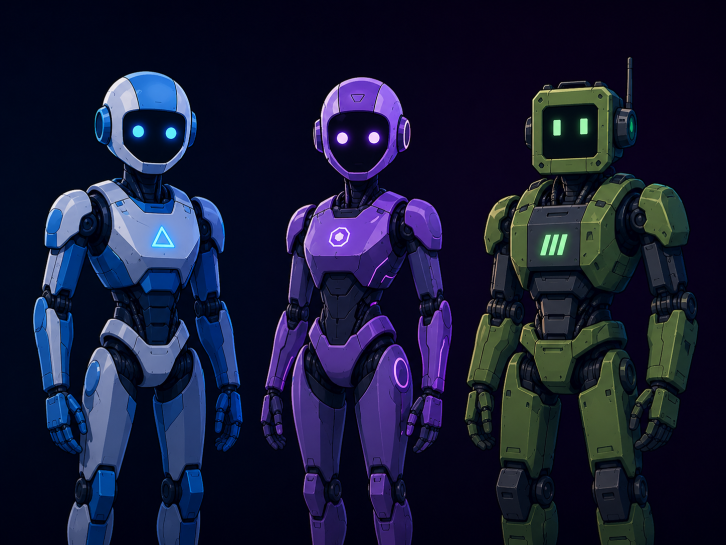
Last year I hired 2 RIT Software Engineers to help me with a Summer Sprint. The whole team used Claude Code’s Pro plan for Teams. Earlier this year I upgraded to Max and have set up 3 agents: Cody the Coder, Tess the Tester, and Desi the Designer. Anthropic pointed out only a small percentage of users have paid plans. And fewer the max plans. So I think I can safely say these are 6 tips from a heavy AI user. I started with ChatGPT but am now using Claude. I tried OpenClaw but Claude quickly adopted a lot of the agentic concepts. I hope these tips help. Let me know if you have any tips I am missing.
MD – Markdown
Markdown is probably something you know about only if you have written a GitHub README.md or use a modern note app like Obsidian or Logseq. What is it? It is a markup language like HTML (ML stands for markup language) that is meant to be a simpler version of HTML. In fact, I realized ChatGPT was using markdown when I copied ChatGPT output into Obsidian and the formatting was already in place.
If you do use Obsidian and subscribe to the “second brain” concept, this should be super exciting. You can copy / paste notes directly from AI into Obsidian. You can ask AI to summarize a discussion and give you a markdown file of the summary. But hacking AI, or at least your agents, now gets way easier. I don’t recommend you do that, but you could.
PRD – Product Requirements Document
I wrote this long prompt to tell Claude about how I wanted it to build and design a site. I then asked it to give me a summary of what I was asking broken into tasks so we could keep track of progress. It titled this document a “PRD” or product requirements document. Definition from Google, a PRD “is a working blueprint used in product management to define what a team will build and why it matters. Created before development begins, it aligns designers, engineers, and stakeholders by outlining product goals, target users, core features, and acceptance criteria.”
A couple PRD tricks. I like to have one PRD for each Sprint. Each Sprint is made up of Projects. And each Project is made up of tasks. For example, I might have an SEO project. I might give Claude data from Google PageSpeed Insights or Google Search Console. I have it research a few sources and provide my own ideas, but I let Claude come up with its own list of SEO tasks and order them in order of dependencies and priority. So SEO-1, SEO-2 … SEO-N so it lists all the tasks it needs to do.
Agents – An AI Team With Clear Roles is a Game Changer
This one is my favorite because I hate testing. I have 3 agents: the coder, the tester, and the designer. And because I am a nerd to the core, I gave them names: Cody the coder, Tess the tester, and Desi the designer. I set up a development and production environment where the development environment is dev.sitename.com and production is sitename.com. So Desi will design a new page or feature, then Cody builds it, and then Tess tests it. Where this gets really cool is they live on two machines and can run at the same time. So Desi may be working on a design and I can give feedback while Cody is coding and Tess is testing. Now I have become the bottleneck. I give Cody the most permissions but they more or less can run autonomously, independently, and concurrently. As Cody builds he may ask for my input. Desi will ask for my input on designs. Luckily, as much as I hate testing, I do not need to do anything there.
They can blow through a week or a month of work in a day or two. As soon as Cody finishes one or more tasks he commits to GitHub on the dev branch. When it is ready to test, I deploy to the host on the dev environment. Tess tests dev. If there are any issues or bugs, Cody fixes. Once we get all green on dev we merge with main, deploy to production, and Tess then tests the main production site. When production is all green, then we start over with a new set of tasks.
SEO – Pro Search Engine Optimization
This was what blew me away more than anything. I have worked at SEO for years. Over a decade on a few. SEO started off as easy because a lot of people didn’t know what it was, but as more and more people started to understand how Google was working, it got increasingly difficult. Google PageSpeed Insights scores on Performance, Accessibility, Best Practicies, and SEO. A 100% on SEO seemed unobtainable, but right now I am 100%. I am 95% and 96% on Accessibility and Best Practices respectively, but the issues are ones I can live with. My organic search shot up faster than I have seen on any other project. Issues like backlinks, which are not something Claude can really impact, are my biggest issue now.
Workflow, Skills & Connected Apps
As for Workflow, I use Claude Code in VS Code. I started setting up a few skills of my own. I have a skill for Claude that tracks token usage by project. So I mentioned I have a naming methodology for tasks. I use a skill name and the task name like TASK-1 and Cody adds token usage by Input, Output, Cache Read, Cache Create, and Total Tokens and estimates the cost using Claude’s API costs. Since API is higher cost than the subscription, these costs are higher than my actual cost, but it give me a good idea of the relative resource cost.
As I started to trust Claude more and more I started connecting to external services like email, Google Sheets, Asana, and my CRM. Ever wanted inbox zero? That seemed impossible but it is done. Want to see resource cost by project? Done. Want to have Claude go through meeting conversations and put followups in Asana. Done.
One thing I try not to do is give employees unnecessary busy work, but Claude doesn’t mind at all. And as tracking Sprint velocity got easier it got equally unnecessary but it does give me a clear picture how long it will take to finish a sprint. Which is to say velocity is increasing, bugs and issues decreasing, and output improving. It is unbelievable.
Resource Tracking & KPIs
Like I said, tracking resource usage and project or sprint velocity now seems almost pointless. KPIs have shifted more from operational related project tracking to more business and revenue driving KPIs. I have two databases: one for the website which is more document related. The second database is metric tracking using an SQL database with Supabase that AI can access to analyze business KPIs itself. User engagement, site traffic, and marketing campaign data is kept in an SQL database with Supabase and the AI can analyze that directly. So as AI was able to drastically improve SEO, it can now look at site metrics and marketing initiatives to improve real business performance that drives revenue.
Amazing in a scary way. I really think we are entering a time of haves and have nots. People that use AI to 5 or 10 x individual performance. Running a one person startup is a real thing.
